-
A Far-Flung Life
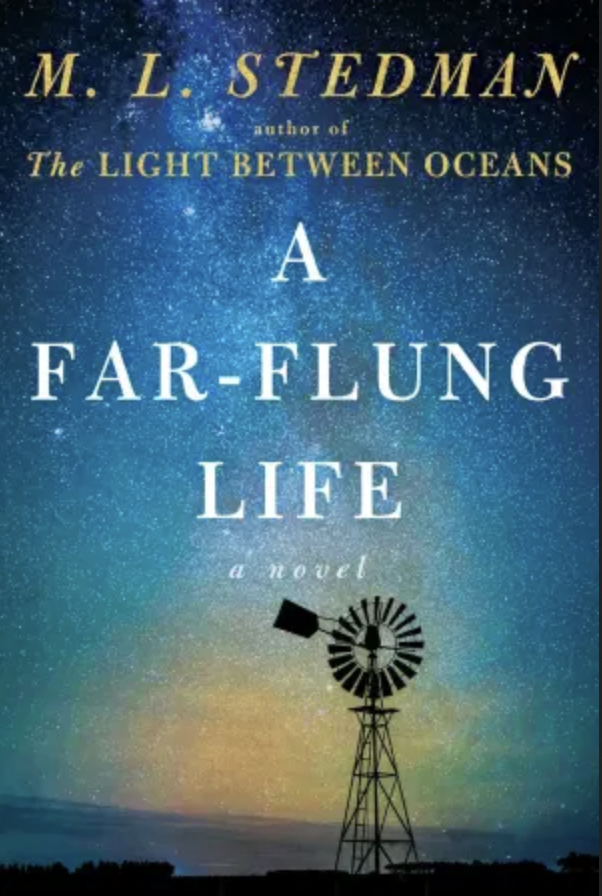
I chose M. L. Stedman’s newest novel, A Far-Flung Life, based on the cover and the title. Something about the isolation of that windmill, silhouetted against the stars drew me in, as did the term “far-flung.” What kind of life could be described like that, I wondered.
I knew nothing else about this book, had read no blurbs or promotional information prior to clicking play on my audio file, but as the narrator began to relate the tale in his sonorous Australian accent I was hooked.
The scope of this novel is as vast as the landscape. The McBrides, owners of a million-acre sheep station called Meredith Downs, are a prominent Western Australia family working to maintain the family homestead in increasingly uncertain wool markets. In many ways, the difficulties and demands of station life are easy to relate to, especially to readers who have had to struggle to make their way. And like many people, the McBrides suffer a terrible tragedy, which the matriarch, Lorna McBride, must find the strength to cope with.
Anyone who has ever felt unmoored from a centering point in life or who has endured personal tragedy can understand the feeling of being far-flung. But Lorna McBride loses everything that tethers her to her once stable and secure life. If she had only found solace in her only daughter, Rose. Instead, Lorna McBride’s fatal error is not loving and trusting Rose enough. And from that failure flows a waterfall of tragedy upon tragedy.
Midway, I began to question how a child born under a dark star would navigate a life constrained by unspeakable secrets. Young Andy is a bit like Monty McBride’s pearling lugger that sits in a shed miles inland, awaiting a possible return to the sea. Andy’s life seems unlikely to thrive. But I had hope that he would emerge whole and well. There is urgency for Matthew McBride as well, for he is, in his own way, another ill-fated innocent.
If I had just one criticism, it would be that the novel was a bit too long, but because life does not resolve anguish overnight, Stedman allows life to unfold, and we feel the weight of time as the characters feel it. In the end, I realized the scope of the novel was purposeful and effective. In the same way, as new characters and storylines are introduced, I wondered if they were necessary, but then I realized that tangential characters are never there for scenery or texture only. From the roo shooter to the town gossip, each person has an important role to play, an intricate thread in the broad saga.
In the same way that Hemingway wants us to feel Santiago’s anguish by taking us out to sea with the old man, urging us to feel each cut of the line, making us witness each bite of the shark tearing away the old man’s dream, Stedman obliges us to live each tick of the McBride family’s grandfather clock, and time becomes an instrument of empathy.
I won’t soon forget this story or its lessons of endurance and forgiveness.
-
The Correspondent
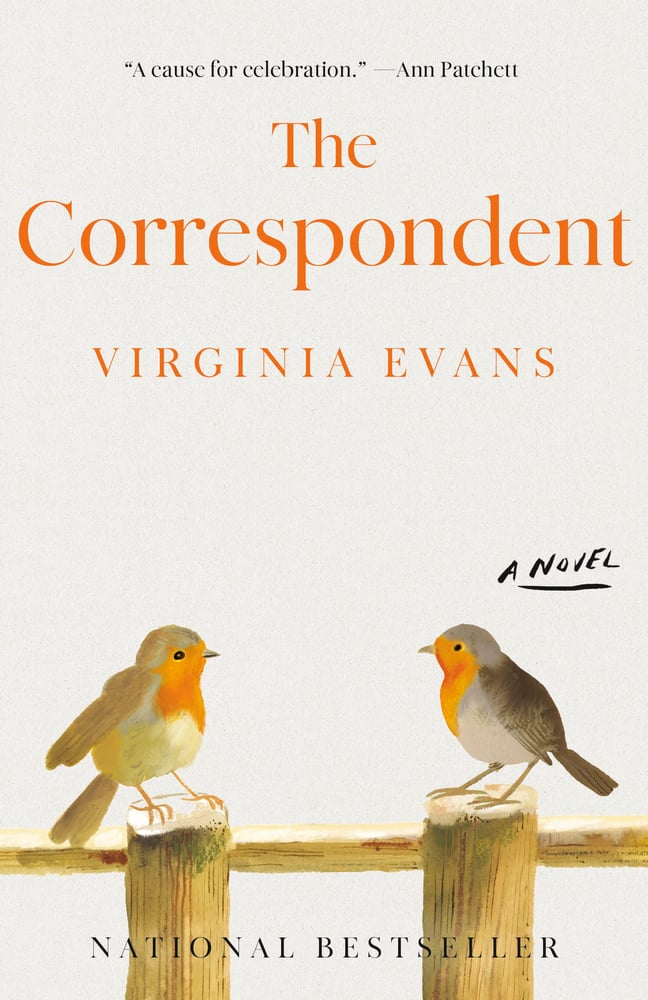
Now and then I will read a book that pulls me into its world so deeply that I am there, and the characters are no longer fictional, but are people that I know. Such a novel is The Correspondent by Virginia Evans.
As a writer myself, I have a pretty high bar for books. This one knocked my socks off with its humor, pathos, and wisdom. Granted, the protagonist is an older woman, as am I, and she’s got strong opinions, as do I, but unlike me, she’s not averse to sharing them, in ways that could be construed as rude. Sybil Van Antwerp can be hard to love at times, and maybe that’s why I did love her. She’s smart, eloquent, and deep down, a deeply loving person, who lives with a devastating secret.
The other thing about this novel that I wasn’t quite sure about was the way it was told, entirely through letters (or email). A supposed “rule” of fiction writing is that a letter cannot carry your narrative and if you must use one, make sure that use is warranted. I have a feeling that Evans had heard that from someone, a teacher maybe, and said, “Oh really….” I’ll admit I wasn’t quite sure I’d like the book for that reason, but my initial doubts were soon erased.
Like Ms Van Antwerp, my eyes are easily strained, so these days I listen to audio books, and this one was a winner. Each letter writer is voiced by a different reader, which was, I think, one of the keys to my enjoyment, as it wasn’t just the story that connected me to these people, but also their voices. Each reader is quite excellent.
I have read (listened to) many good books this year, but this one–this one will never leave me. I could not recommend it more.
-
Boon: Fifty Poems by Karl Elder, a review
Disclaimer: Midwestern poet Karl Elder was my adviser and mentor when I was an undergrad at Lakeland College in the late 1980s, and then beyond when I worked with him in a supportive role for the Great Lakes Writers Festival. Elder, more than any other person, taught me poetry and poets. I am honored to write this review of his latest poetry collection.
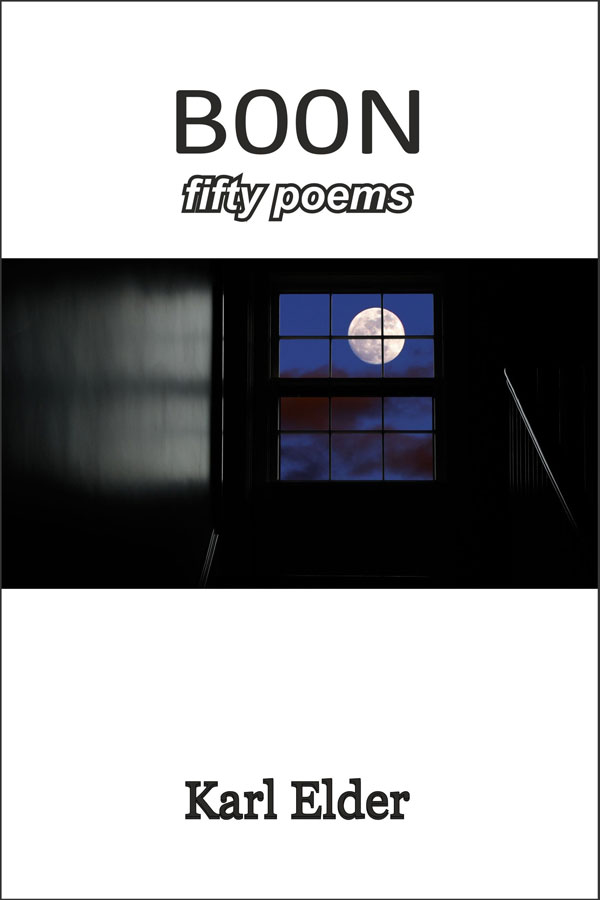
Boon: Fifty Poems by Karl Elder showcases the poet’s keen eye and ear. A metrical and metaphoric feat, in language as precise as a sculptor’s chisel in stone, Boon echoes the voices of legends: Stevens, Dacey, Dickinson.
Light and color abound in Boon, as in the poem “11/11,” where in November a solitary maple tree atop a hill still blazes red, “crimson on a stick.” In “A Prose Poem,” Elder presents the nostalgic image of an “old time radio” whose tubes seen another way are a tiny lighted city before traversing imagination into an open countryside where gravestones accomplish a similar, if dimmer, effect.
Reminiscent of Stevens’ Blackbird, Elder’s “L’Hommage,” asks us to look again and again at Rodin’s sculptures as commentary on human comedy and tragedy, that in the end require contemplation: “a chin on a fist.”
In forms free and fixed, Elder shows us new ways of sensing life around us—showing us, as those old transcendentalists did, the sublime in the ordinary.
Boon is filled with joy, humor, wit, and pathos, and at every turn a surprise—an image or idea wholly unexpected.